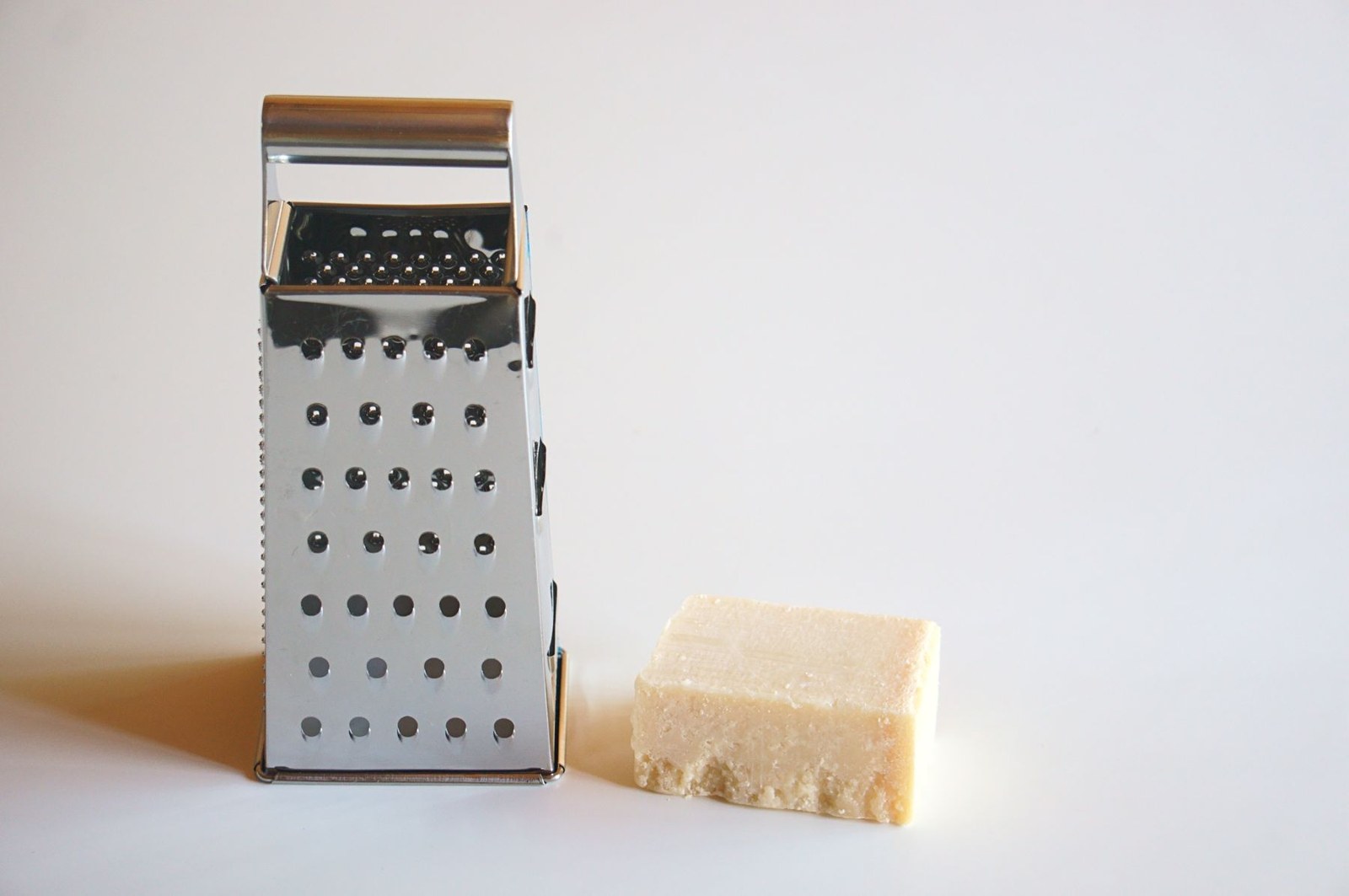
A box grater can replace several small tools, but only if its surfaces match your cooking. Coarse holes may suit vegetables or cheese; finer surfaces can produce a different texture. A slicing face adds another function, although it may not be as convenient as a knife for the same task.
Look at the ingredients you prepare most often. If you rarely use the very fine face, paying for a large multipurpose grater may not offer much advantage over a smaller tool. Conversely, a compact handheld grater can feel awkward when you need a generous quantity.
Stability matters more than piece count
Set the grater on a suitable board or other surface the maker recommends. Its base should sit securely rather than rock as you move the food. A non-slip edge can help, but it needs to be clean and correctly seated.
Check whether the handle leaves enough room for your hand and whether you can hold the tool without placing fingers close to the working surfaces. Keep hands away from the teeth as the ingredient becomes smaller. Use any suitable holder supplied with the product; do not push your fingertips closer just to avoid leaving a small piece.
Consider how the grated food will be collected. Some models have a box that fits underneath, but that box adds another part to wash and store. Without one, make sure there is enough space to lift the grater and gather the food without scattering it.
Plan for washing the sharp surfaces
A grater needs careful cleaning around its teeth. Follow the maker's directions rather than wiping against sharp edges with an unprotected hand. A suitable brush may help reach residues while keeping fingers away, if recommended for the tool.
Inspect the base, handle and any removable panels over time. A loose grip or unstable body makes repetitive movement harder to control. Store the grater where the sharp surfaces will not catch someone reaching into the cupboard.
For most first kitchens, a stable tool with one or two genuinely useful grating textures is enough. More faces are valuable only when you understand their jobs and can clean them comfortably.