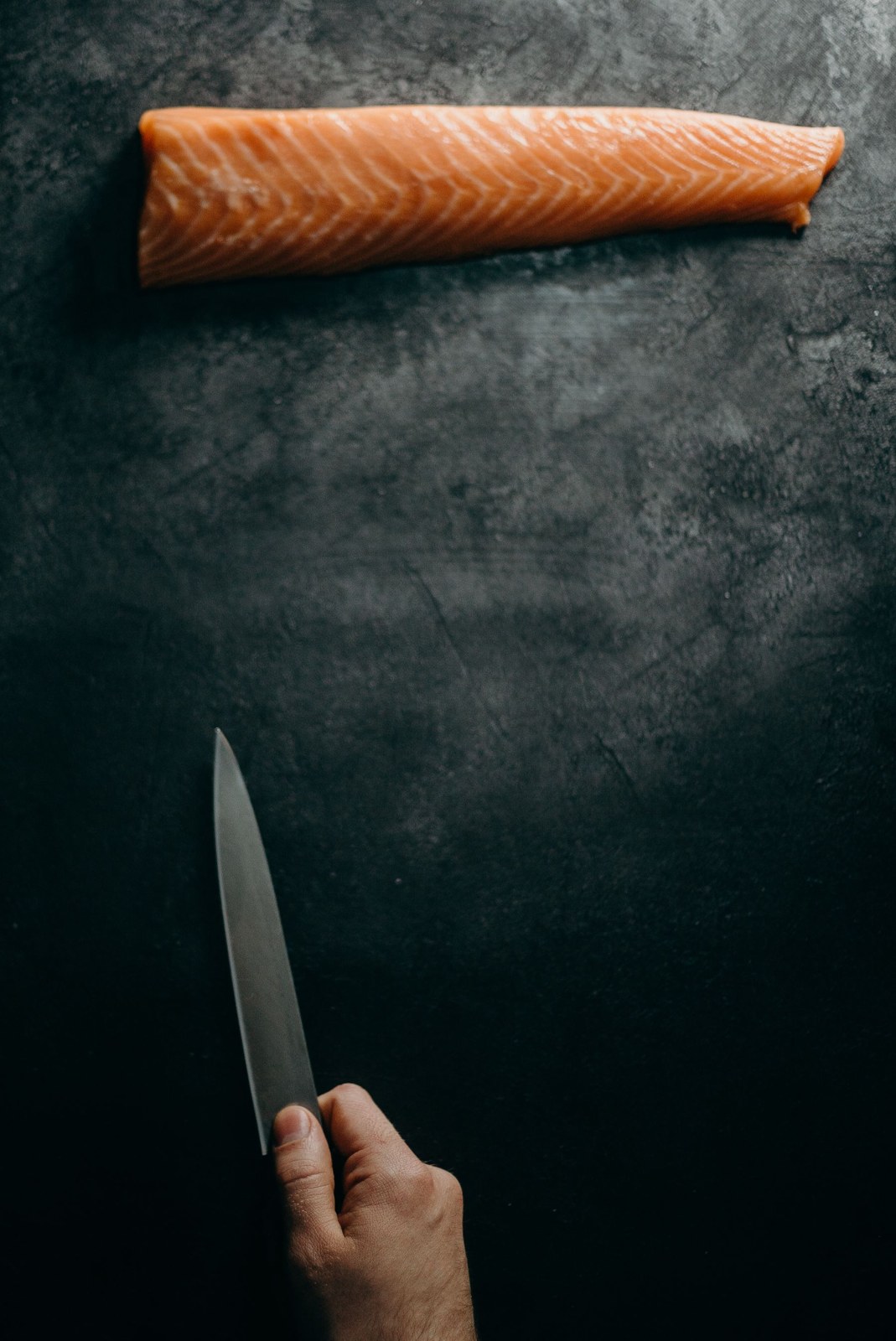
The knife you reach for most often should fit the way you prepare vegetables, herbs and other everyday ingredients. That does not necessarily mean the longest blade or the largest set. A chef knife is a general-purpose tool, but its size, weight and handle shape can make the same task feel very different.
If possible, handle a display model before buying. Check whether your fingers have room around the handle and whether you can hold it without squeezing awkwardly. Do not test sharpness on your skin or make cutting movements in a shop without permission and a suitable setup.
Look at the space beneath your hand
Blade height affects the clearance between your knuckles and the board. A knife that feels comfortable in the air may be less comfortable when its edge reaches the cutting surface. Your board's position and the counter height also affect the working angle.
Length should suit both the ingredients and the board. A longer blade can be useful for larger vegetables, but it needs enough space to work. If your only board is small, buying a very long knife may introduce a mismatch rather than solve one.
Weight and balance are personal considerations. A heavier knife is not automatically easier to control, and a lightweight one is not automatically flimsy. Think about repeated preparation, not one forceful cut. You should not need to use the knife as a lever or force it through food it is not designed to handle.
Budget for keeping it usable
Read the care instructions, including washing, drying and sharpening. A knife should not disappear into a sink full of water where someone might reach for it unseen. Choose a storage method that protects the edge and makes handling predictable, such as an appropriate guard or a stable storage block.
Sharpening arrangements matter as much as the initial edge. Some owners use a professional service; others learn a suitable method for their blade. A honing tool and a sharpening system do not necessarily perform the same job, so avoid buying one without understanding its purpose.
Start with a knife whose maintenance you can manage. Add specialized blades only when a regular task calls for them. A comfortable general-purpose knife, an appropriate board and careful storage are a more useful foundation than a crowded block of unfamiliar shapes.